

Random
Vertices of a Hypercube

JMJ
Preamble
No two randomly shuffled decks of the standard 52 playing cards have ever turned up in the same order, ever, in the history of the universe.
Never.
Not even once.
It is basically a mathematical certainty that this is true.
How Small “Big” Can Be
Modern people like to talk a lot about Infinity.
Maybe you’ve noticed?
It’s a recurring conceit in fiction, for example. Infinity is the theme of countless “smart” YouTube videos. For a certain class of person, it’s become something of a pastime to wax philosophic about the “infinite number of numbers” between 1 and 2. There’s a whole type of guy out there who enjoys bringing up pi and talking about how its digits never stop, or other numbers like it, e for example, or The Golden Ratio. Neil deGrasse Tyson made a whole career out of appealing to such people. Getting up on T.V. and waving his hands around, talking about all the various kinds of infinities in the cosmos. Our movies have plot devices called “Infinity Stones” and “Infinite Earths”, and not a few people sincerely believe in the (completely unsupported by any evidence whatsoever) notion of a “multiverse”, the idea that there are ¿¿¿somewhere??? out there infinite copies of themselves, and that maybe some of those copies aren’t failures. Some of them are rich. Sexy and desirable even. A guy named Hilbert invented an infinite hotel. For 21rst century Man, it is simply common knowledge that Shakespeare and an infinite room of monkeys are more or less equivalent.
This is all very silly.
I mean, believe me, I understand the seduction of large, paradoxical abstract concepts as well as anyone, but our cultural obsession with infinity ignores the fact that the vast majority of people have yet to get their heads around numbers that are even just kind of big. The average man or woman simply has no business playing footsie with the infinite. Heck, most adults, probably even you, have long since forgotten how to do division.
So you know, put down the gun Sally.
You’re not ready for The Big Maths.
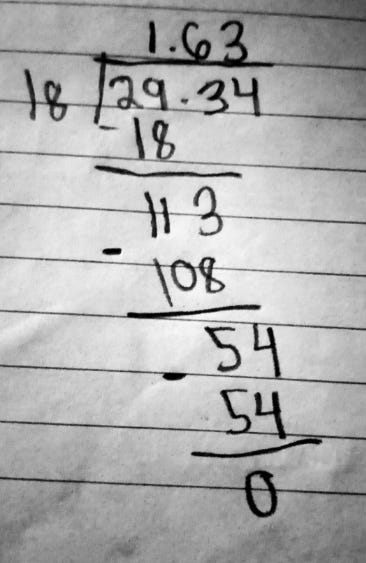
Let’s take “A Million”, for example. People have no idea how big “a million” actually is. “He’s a millionaire.” “She’s a millionaire.” “A million years ago.” “A million people.” “A million lightyears away.”
Etc.
People use the word “million” all the time but have no sense for how much “a million” would be in reality. It’s one thing to write six zeros in a line on paper but, in the physical world, if I actually gave you a million anything you would be shocked and totally overwhelmed. A million of ***almost anything*** would totally derail your life, if for no other reason than that there’d be no place to put it all.
For example, what if, today, you received a delivery of one million pencils? One million. Depending on the brand, you’re looking at finding a place for over six thousand pounds of writing utensils in your home. The weight of it all might legitimately break through the floor. You know, hope you didn’t need that living room. It’s the pencil room now, buddy. Also, so is the kitchen. Know what… better prepare to give up your bedroom too because… *delivery men continue bringing in box after box after box*… this… this really is quite a lot of pencils.

Or, you know, you walk into your local library and think, “Wow! There are so many books in here! Millions!”
Nope.
Not even close.
In the U.S.A. most public libraries house somewhere in the neighborhood of a couple hundred thousand volumes. While it’s true that, in large metropolitan areas, you can find libraries that break a million, only exceedingly large ones, like the New York Public Library, are going to have enough titles on hand to properly earn the exclamation point on the end of that “Millions!”
“A Million” is so much more than you think.
The entire country of Iceland, for example, has less than half a million people. The entire state of Rhode Island is less than a million acres of land. If you were to drive your car one million miles, you’d have covered enough distance go around the equator roughly 40 times.
A million is a lot.
It’s more, really, than the average human mind can properly comprehend.
In the abstract? Sure. Like I say, we can write the digits down on paper, or in a computer program. We know how to work with numbers like “one million” when they’re not attached to anything physical and real. Translate it into physical reality however, and it’s way too much. The brain can’t adequately process what that’s like and, unless you really meditate upon it, all the big, enormous numbers people like to throw around regarding the economy, or the distance to various stars, or the age of the universe or what have you, don’t actually have any meaning. People just file them all away in their heads under the same folder labeled “Big.”
… But they have no idea just how Big “Big” can be.
“A billion years”, for example.
No idea what you’re talking about.
None.
Every time you’ve ever uttered that phrase you’ve been talking nonsense, even if you were technically accurate. “A billion years” is so long it’s literally incomprehensible, not just to you, but to everybody, myself included. “A billion” is as unfathomable a length of time to the average garbage man as it is to the average astrophysicist because, remember, you have trouble remembering what you ate for lunch yesterday, and making plans more than a week in advance feels stressful. So, you know, don’t tell me you have a sense of “a billion years ago,” okay?
Because you just don’t.
This is one area where education makes it worse. Gives people a false sense of confidence. I mean, Avogadro’s Number? Good God. Why are we pretending highschool kids can understand such a thing? College kids can’t. Neither can most PhDs. Why? Because Avogadro’s Number is 6.02×10²³.
Ten to the twenty-third!!!!
That’s ludicrous.
Ludicrous.
It’s a ludicrous number to try and conceptualize and, frankly, most of the apparent reasonableness of The Modern Creation Myth rests on people’s inability to understand Size and the scale of the things Science is actually talking about. Once you actually grok it… once numbers stop being simply “Big” and you start to understand how small some “Big” numbers can be in comparison to others…
The whole notion that we evolved from random processes just completely falls apart.
Completely.
Biologists are retarded you see? They don’t understand numbers.
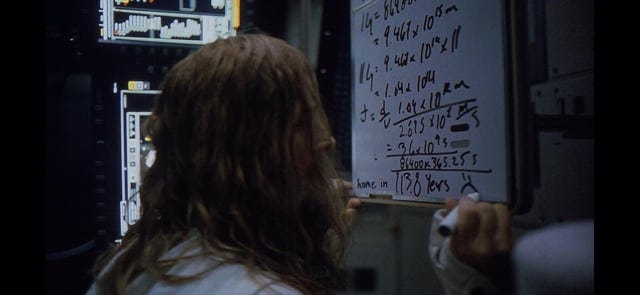
Here. I will state my thesis plainly: Evolution only feels believable to people because, again, above a certain threshold, all large numbers just get filed under “Big” in people’s heads.
That’s it.
Mankind’s inability to conceptualize large numbers is the only reason anyone has ever taken Darwin’s theories seriously. Only reason. You point out to somebody how improbable it is that Life would spontaneously arise from the random fallout of a random explosion and they go “Yes, well, but there was an infinite amount of time for it to happen so…”
And they shrug.
You know, because to them all large numbers are just… “Big”.
But, see, there wasn’t an infinite amount of time for Life to happen.
There actually wasn’t anywhere even close to it.
Current best estimates put the age of the universe at around 14 billion years, which, compared to infinity, might as well be a microsecond. If you understand the actual statistics behind the claim, you understand that even the most generous cosmology gives you nowhere near the amount of time or space necessary to make the formation of even one cell by random chance remotely plausible.
That is a fact.
I’m telling you a mathematical fact.
It can’t happen. The creation of life by random chance could simply never occur.
How Big “Big” Can Get
Graham’s Number is one of the largest numbers ever actually “used” in mathematics. I put used in quotation marks here because, what’s actually been accomplished by employing Graham’s number is questionable but, it was proven to be an upper bound of the answer to the following question:
Connect each pair of geometric vertices of an n-dimensional hypercube to obtain a complete graph on 2n vertices. Color each of the edges of this graph either red or blue. What is the smallest value of n for which every such coloring contains at least one single-colored complete subgraph on four coplanar vertices?
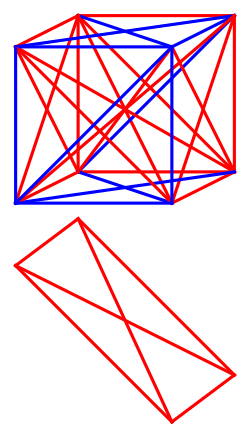
Sort of.
Graham’s Number, G, never actually appears in the paper he wrote about this problem, but it was apparently a simpler number to explain than the actual answer he came up with in his proof.
Anyway, Graham’s Number is so large that you have to use a special notation scheme to write it down, or even talk about it, because, and, I need you to keep in this mind, this is not an exaggeration, there is not enough physical space in the universe for it to be written down the normal way… even if every digit were the size of an atom.
Again. That’s not in any way an exaggeration, and actually quite a bit undersells it.
Here’s how you write Graham’s number:

Don’t feel dumb if you don’t understand it.
You don’t need to.
It’s a stupid number intended to solve a stupid problem and it has no relevance whatsoever for the real world.
Completely useless.
BUT!
Usefulness aside, Graham proved that the answer to the question:
“What is the smallest value of n for which every such coloring contains at least one single-colored complete subgraph on four coplanar vertices?”
Is somewhere between this enormous number, G, …
and six.
Yes. 6.
As in, one, two, three, four, five… six.
So, the smallest value n is somewhere between 6 and this number so enormous that it dwarfs the number of atoms in the entire cosmos millions and billions and trillions of times over.
And, I have to stress to you that, to mathematicians, people that actually understand numbers…
That’s basically a bullseye.
Like, seriously.
Problem fucking solved.
Right?
I mean, sure, to normal people “an answer” between 6 and an uncomprehensible value so large it defies normal mathematical notation might seem a bit lacking but, in comparison with infinity, with all POSSIBLE numbers, we’ve basically got it. We know the answer to the question about hypercube colors with mathematical precision. So… homerun. Next. We knocked it out of the park. Great work everybody. Let’s go home.
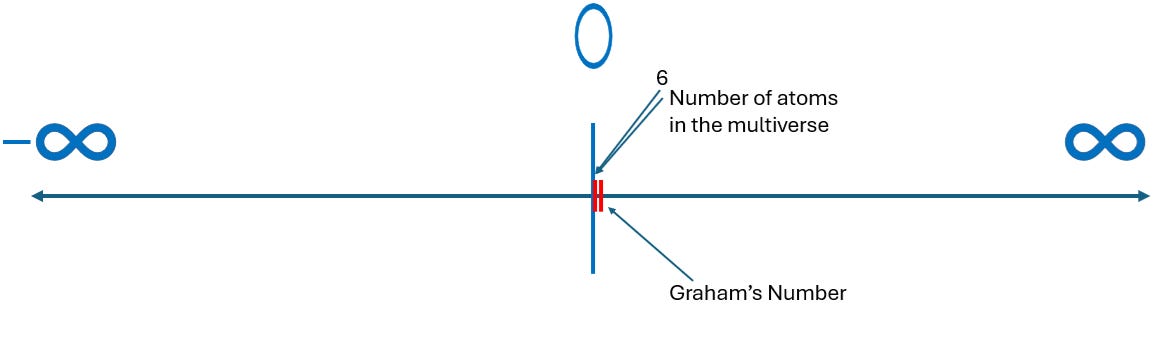
And I go through that little bit of levity to try and get you to see how big infinity actually is, and how all the numbers labeled “Big” in your head are actually nowhere near the same.
Like I said, the age of the universe is said to be about 14 billion years.
14 billion just isn’t big enough.
Not for you and me and the marmosets in Brazil to have evolved from the result of random chance…
14 billion simply doesn’t give us anywhere near enough time. People think it does because large numbers make no sense to them but, if you run the stats, 14 billion comes up way, way too short. Graham’s Number of years? That would maybe be sufficient. 14 billion though? For the purposes of the spontaneous evolution of life…
14 billion years might as well be 6.
See, the narrative around evolution was handed to you by people who wouldn’t know what to do with a million pencils. They hand-waved all the complexity of Life away by constant reference to longer and longer timescales, hoping to win the day by appeal to a sufficient number of dice rolls.
Problem is, they didn’t actually do the math.
They completely underestimated how many dice rolls Life would require.

As stated at the beginning, no two randomly shuffled decks of cards have ever in the history of the universe turned up in the same order.
This surprises you.
I know it does because it surprises everybody because, as mentioned, human brains don’t do well with large numbers, and we are easily confused.
It’s especially jarring because, unlike the hypothetical million pencils, or million miles driven in a car, a deck of cards is something we’ve all held in our hands. It’s something we’ve all dealt with. Over the course of our lives, most of us have probably shuffled such decks a few hundred times. Those 52 cards in a deck just don’t seem overly complicated and, yet, the number of possible orders they can be in is known quite precisely.
It’s 52! .
There are two punctuation marks there because the ! is a bit of mathematical notation called a “factorial.” The number of possible card orders in a deck is 52! . Fifty-two factorial.
It’s a simple concept, really. If you’re not a maths person don’t be afraid. Factorials are defined very straightforwardly, and the definition is just:
n! = n × (n - 1) × (n - 2) × (n - 3) × ... × 1
Where, “n” is the number or “degree” of the factorial in question.
So, 1! would just be, 1.
2! would be 2 × (2-1) = 2 × 1 = 2.
3! starts giving you the feel for the thing and goes like 3 × (3-1) × (3-2) = 3 × 2 × 1 = 6.
And so, 4! = 4 × (4-1) × (4-2) × (4-3) = 4 × 3 × 2 × 1 = 24.
5! = 5 × 4 × 3 × 2 × 1, and 10! would be 10 × 9 × 8 × 7 × 6 × 5 × 4 × 3 × 2 × 1 = 3,628,800
etc.
As you can see, factorials “blow up” pretty fast. 2! is 2, but 10! is over three and a half million.
To see how this applies to a deck of playing cards, let’s take a simple example. A, B, C. How many ways can you arrange these letters?
Well, you’ve got ABC, BAC, CAB, ACB, BCA, and CBA. Right? Six ways, and, as we saw, 3! equals six.
I won’t bore you with the proof but, suffice to say that this pattern holds generally and, if the number of ways you can arrange three things is 3!, then the number of ways you can arrange four things is 4!, seven is 7!, and ten, 10!. In fact, the number of possible orders for a set of things in a sequence is always NumberOfThingsInTheSet! .
A fifty-two card deck has, therefore 52! possible orders which the cards can be arranged in, and 52! comes out to be:
80,658,175,170,943,878,571,660,636,856,403,766,975,289,505,440,883,277,824,000,000,000,000.
Which…
is big.
Really… really big.
Not Graham’s Number big. No. Not even close. But it’s more than like, you know, the number of ants in the world or something. It’s a lot.
Keep in mind, a trillion (which is one million millions) is only 1,000,000,000,000. 52! is so much bigger than that that a trillion goes into 52! approximately 8.1 × 1055 times.
8.1 × 1055.
Ten to the fifty-five!
Avogadro’s number, remember, the number of atoms necessary to equal an element’s atomic weight in grams, is only 6.02×10²³, meaning there are astronomically more ways to arrange a single deck of 52 cards than there are atoms in, say, one of those 45-pound plates people like to lift in the gym.
Not just a little more.
Astronomically more.
52! is so large, in fact, that in order to have a decent chance of any two random shuffles producing the same order of cards, you’d have to shuffle a trillion decks of such cards a trillion times a second for a trillion years… several trillion times over and over again.
That’s not an exaggeration or hyperbole.
That’s stone-cold math.
Don’t believe me?
Here’s Neil deGrasse Tyson to confirm.
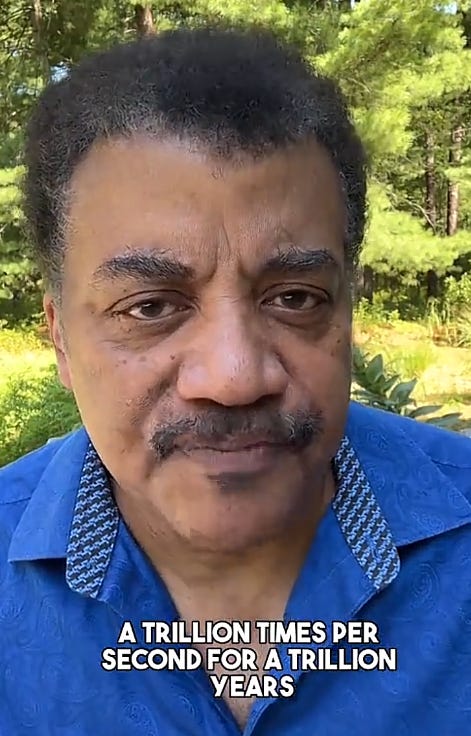
Okay so those are the odds when you have 52 variables. To get 52 things in a specific order you need a trillion randomly shuffled decks a trillion times a second for a trillion years across a trillion civilizations and then some to approach the possibility of maybe getting any one specific result. That’s the math for 52 variables.
…
Right.
So, how many variables you reckon this has?
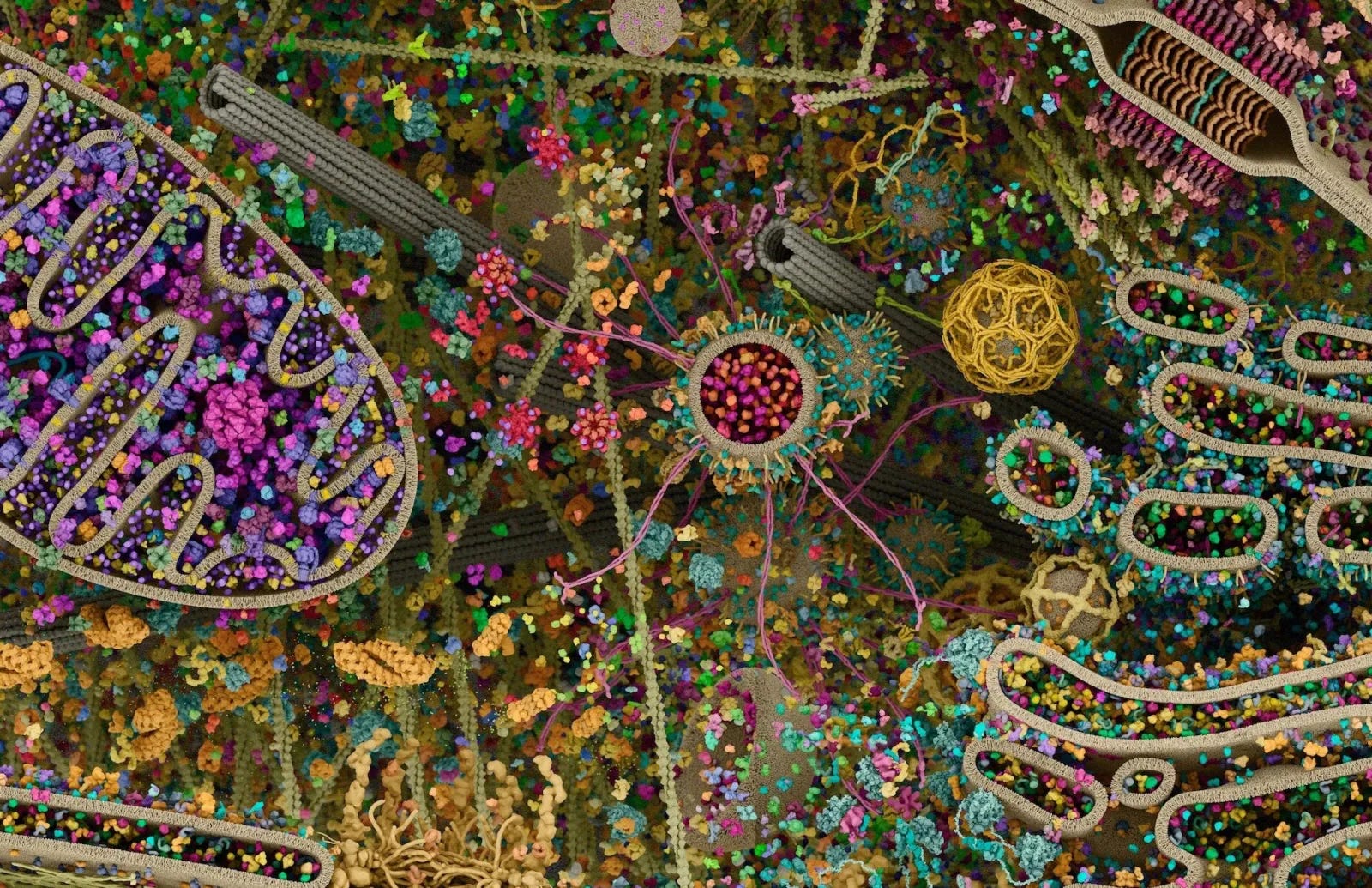
Electron scanning microscopes didn’t exist when Darwin was around. His generation knew Life was made out of cells but thought, quite erroneously, that whatever was inside a cell must surely be pretty basic, simple stuff. At the time they only knew about a few of the organelles inside the larger plant cells, and about a few other bits and bobs. That was it and so, at the time, (again, I must stress to biologists, e.g. people that struggle with addition), a few million years probably seemed more than adequate for random chance to produce the amount of observable complexity they were able to see. Technology marches ever forward though and, today, we know that even the simplest organisms, those which don’t have all the organelles of eukaryotic cells, nonetheless still possess a complex array of internal machinery to keep them functioning and, indeed, we are still discovering new details about their inner workings all the time. The cells of animals and plants are an even larger step forward in complexity, full of incredibly intricate smaller structures like chloroplasts, flagellum, the Golgi apparatus, the nucleus and the mitochondria, photodetection spots, glycosomes, and numerous other things, all of which are then, in turn, themselves made up of smaller and similarly complicated structures.
Example. Here’s what’s inside the mitochondria, one single organelle. A tiny part of the overall cell:
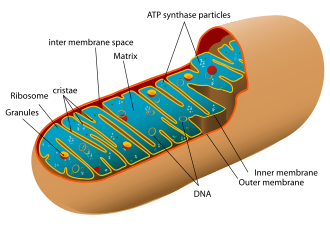
And so my point here, which I think any honest person must concede, is that the number of things which would have to happen in the universe, at random, to produce even one single celled organism is outlandish. Random chance, random mutation, random environmental conditions, random astronomical conditions like the distance to the sun and the effects of the moon, it’s all way more than 52 variables, and it would therefore probably take somewhere on the order of Graham’s Number of years to shake out into something like an amoeba. Of course, I understand that people are going to try and wiggle out of this problem by saying something like, “Well, no, but, you see, the mitochondria did not arrive in the first cell fully formed. No. It started with something much simpler, which in turn came from something simpler, which in turn, and so on…”
Doesn’t matter.
Doesn’t help you at all.
At the end of the day, you’re still trying to suggest that complex life with all its interlocking parts was produced by random events. The simpler thing that was the ancestor of the simpler thing that was the ancestor of the mitochondria was still incredibly complex, and all the complexity it adds to itself over time to become the organelle we know today had to be added one piece at a time… randomly.
Like I say, I will happily concede to you that, like the infinite hypothetical monkeys banging away on infinite hypothetical keyboards, given INFINITE time, something like a bacterium would, probably, come into existence by accident, provided that all the matter in the universe were sufficiently banging around against itself.
YOU DON’T HAVE INFINITE TIME THOUGH.
You have 14 billion years.
…
And that might as well be six minutes.
It’s just nowhere near enough.
Keep in mind, we’re not just talking about all these individual pieces coming together just so in the first proto-organism (the simplest viruses have around 2000 base pairs, which… again, that’s 2000 variables you have to get randomly), but also that proto-organism then successfully reproducing itself *waves hands* by magic?… and then those surviving long enough on a planet subjected to random fluctuations like meteor impacts, cosmic rays, extreme heat and cold, and long periods of rain or drought.
And that’s just the bare minimum to get evolution started.
Bare minimum, and it’s already hopelessly complex.
All that is to say nothing of, as mentioned, all the cosmic forces and planetary alignments that would also have to have formed randomly, just so, to make a random location like Earth randomly amenable to life in the first place. And then, provided all that, and provided the first bit of proto-life gets going, you still have an uphill battle from there of around ten billion googolplexes of random events that need to happen to get to a lion on the savanna or a girl staring at you with a human eye.
It can’t happen.
It’s so statistically improbable as to be impossible to anyone but the insane.

Of course, Darwin tried to argue otherwise. But, again, he was a biologist. He didn’t understand math.
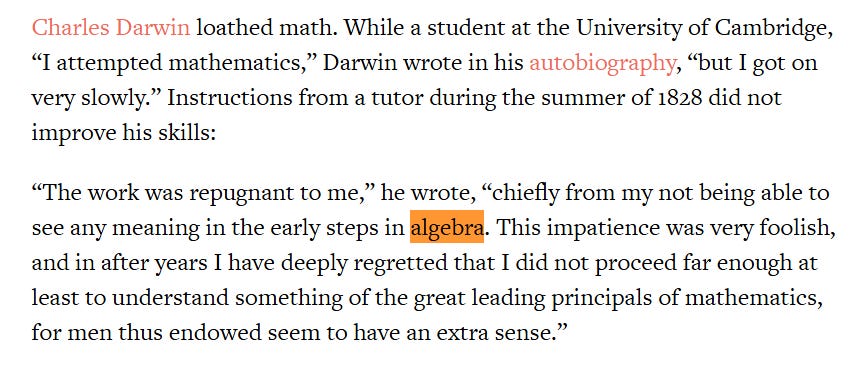
In Origin of Species Darwin wrote: “[the evolution of the eyeball] seems, I freely confess, absurd in the highest possible degree.” He was correct. He should have stopped there and gone home. It is absurd to suggest that eyeballs are the result of 14 billion years of things banging around together at random. However, Darwin (like essentially all the biologists after him) didn’t understand large numbers, statistics, or time, and thought that he could gloss over this problem if only evolution were very slow and the universe fairly old.
You can’t though.
There’s simply not enough time (or, frankly, space, but that’s a different matter).
Again, if the universe were Graham’s Number years old… it would be a different matter. Of course, even the simplest atoms might all decay away to nothing in such a length of time but, at least a Graham’s Number of years would make the idea of Life by random chance somewhat plausible.
But 14 billion?
…
… …
See, everyone is talking out their ass.
“When the universe was a few minutes old it was incredibly dense and very hot. So much so you see that hydrogen could fuse into helium and then, a few million years after that, all the hydrogen and helium became stars and then after a billion or so years those stars made all the heavier elements and then…”
Fuck off.
Like, seriously.
Be real for a second here because there is zero damn chance that you know what happened “when the universe was a few minutes old.”
Zero.
People who talk like that are just farting with their mouths.
It’s all nonsense you see? It’s a fable. What the scientists are giving you when they talk like that is nothing more than an alternative creation myth. One every bit as verifiable and evidence-based as the one in Genesis.
“The planets were made when ancient stars exploded in supernovas, spewing their elements millions of lightyears out into the galaxy. As they cooled, due to gravity, all these elements would cluster together into clumps. At first these masses were irregular but, slowly, over time, they fart fart toot fart toot.”
Bullshit.
Total bullshit.
You may safely disregard anyone trying to claim he or she has “knowledge” about something that happened billions of years ago.
They don’t.
It’s all just guesses.
It’s made up.
It’s fake.
I’m not telling you that you therefore have to believe the creation myth in the Bible, or the one in the Koran or the one in the Rig Veda. I’m not saying that your only recourse is to now believe that Odin fashioned the Earth from an ice giant’s corpse.
What I am telling you though is that it would take a trillion civilizations a trillion years of shuffling at a trillion times a second to get two randomly shuffled card decks into the same order…
But that YOU can make any two decks the same, anytime you want.
Because you’re conscious.
In the beginning was The Word.
You see, one conscious, thinking actor can produce an outcome in a few seconds that it would take random chance from now until the Heat Death of the universe to come up with.
Maybe, therefore, that’s reason enough to suppose that such an Actor did.

It is easy to notice that so many of our mental processes are just a more articulate version of the primitive's "One, Two, Many."
I'm here for the biologist intelligence denigration
They are *literally* the people who The Mitochondrion Is The Powerhouse Of The Cell