

Why We Are Sick
The Endless Ocean

“Judge not, lest ye be judged.”
We are accustomed to thinking this applies only to people.
Chronic illness is a bitch of a thing, and what strikes me most about it is just how little anybody seems to be able to do for it. One would think that, in 2026, a great many more illnesses would be things of the past than actually are. And yet, all the time, every day, one encounters people in need of dialysis, or mood regulators, or suffering from pain or heart palpitations or infertility, and there seems to be no cure for any of these things.
Treatments?
Oh, certainly.
There are endless treatments.
The number of avenues our society has created to get individuals plugged into the medical system and dependent on it for life is practically infinite. The number of cures however…
Well, that’s quite small.
Think about it. When was the last time a cure was invented? No recent examples spring to mind. Alexander Fleming accidentally discovered penicillin in 1928, and that was revolutionary, but, other than the advent of antibiotics, medicine has given us very little in the way of permanent fixes. Until recently I would have also included vaccines as similar successes but, after all the redefining of words they did a few years back, it seems as though doctors are no longer holding to the claim that vaccinations provide immunity. The much lauded needle has now, apparently, also been relegated to the status of a “treatment” instead of cure, intended these days only to help you get “less sick” instead of preventing your contraction of the illness altogether.
¯\_(ツ)_/¯
Oh well.
Nothing I can do about it. I was not consulted by the WHO.
So glaring is this issue that a cynical person might be tempted to conclude that such is the point of the Health Care Industry. Not to make people healthy so much as to generate cashflow. They would say that we have a subscription-based model of medicine built around “managing symptoms” via lifelong reliance on drugs, surgeries, and doctors. Cure a man, and he pays you once. Manage his symptoms however, and he pays you forever. Physicians are, after all, definitionally Drug Dealers, sometimes deserving of all the negative connotations such a term implies. It is, for example, hard to see how a methadone clinic is overly different from getting a bag of crystals from a guy named Zeke, or how some pain clinics are much more than dispensaries for opium. This admitted, I confess that I have never been able to convince myself to become that cynical. To think that the Health Care Industry is actively trying to keep people sick on purpose.
My own experience with the medical community has led me rather to believe that most people within it have good intentions, yes, even on the insurance side of things. Rather than being a vast capitalist conspiracy, the reality instead appears to be that Health is simply quite complicated, comprised not only of the body’s functioning as an organism, but also of economic constraints and cultural expectations… to say nothing of federal law. As far as I can tell, frankly, the answer is simply that much of the time doctors just don’t really know how to help you.
And I think we would all benefit greatly if they more frequently said so.

Now, I am not against modern medicine, per se, but I do believe it thinks much too highly of itself. Any other industry that received as much public funding as Doctors do would, frankly, be embarrassed by their lack of output. Hippocrates was born 2,500 years ago, and yet they still can’t do anything for the common cold. Diabetes is still a problem. There remains no way to rid a person of herpes or HIV. If you’re going to march into the room like God and put people in paper gowns through the maw of a bureaucratic machine equipped with bone saws, then you ought to at least have the self awareness to know that everything your industry has done up to now has raised human life expectancy not at all since Biblical times.
As The Good Book says:
“Our lives last seventy years, or eighty if we are strong.”
That’s Psalm 90. Purportedly the oldest psalm in the Bible, and attributed to Moses. It was written… well…
A long ass time ago.
… And most people still die around 75.
Lyme disease continues its rampage unabated. Nothing can be done for Ebola except to sit around and wait for outbreaks to burn themselves out. Despite untold billions being funneled specifically into breast cancer research, still, today, often the only thing they can do for you is cut your tits off and hope for the best.
It’s all very non-ideal. Medical “progress” has been glacially slow.
As my friend Reinhardt once so eloquently put it, maybe their best trick is when they just repeat your symptoms back to you in complicated jargon (or worse, in Latin!) and call it a “diagnosis,” as if this justifies their enormous salaries. “You have Irritable Bowel Syndrome.” is just a fancy way of saying “Your tummy hurts a lot.” to a person already complaining to you of stomach pains. Likewise, a diagnosis of “Clinical Depression” doesn’t tell the patient anything except that you, the clinician, agree with them that they are in fact depressed.
From a certain perspective then, the whole thing does look like a house of cards. If people seem skeptical of physicians and medical advice therefore…
Well, perhaps they can be forgiven.
Of course, far be it from me to declare doctors useless. No. On the contrary. Indeed, I hope I am never guilty of giving criticism without corresponding praise. Despite these numerous problems, doctors, surgeons, and nurses are routinely capable of minor miracles. There’s never, for example, been a better time in history to get shot with an arrow. Never have the options for repairing your face after being caught in a house fire been so vast. Any issue you have involving some acute, well-defined, mechanical problem, such as a leaky valve, a torn ligament, or a growth that needs to be removed… they can usually fix. This is not nothing. Human bodies often get mechanical problems. Over the course of our lives they may need sewing back together, to have parts replaced, or to have something removed or bolted on. Doctors are great at these things. The issues only come in, to my estimation, when the problems the doctor encounters aren’t mechanical. When the Human Body is acting, mysteriously, as more than the sum of its parts.
…
I put this down to bad philosophy.
That’s a nicer way of saying what I really think, which is, “The issue is that they don’t believe in God.”
Not that they could help it.
Modern Medicine is a child of the Industrial Revolution, like everything else, and almost nobody escapes being a product of their time.
Mark you… when the story of Genesis was first being passed around the campfire as an oral tradition, the highest technology available to men and women was that of Pottery and so, naturally, God was said to have formed our bodies out of clay. In the age of Hesiod, they had metallurgy, and so he naturally described the ages of Man as being of gold, silver, and bronze. William Osler and William Welch however, found themselves to be contemporaries of Henry Ford and Nikola Tesla and so, equally naturally, the Medicine and Pathology they invented couldn’t help but equate our bodies to engines and circuitry. The heart, long believed to be the center of a man’s soul, became in the age of automobiles nothing but a pump. The kidneys, which hitherto aided in Man’s relation to the elements of nature, were demoted to a mere filtration system. All our vessels suddenly became so much plumbing, and our nerves were known to be simply electrical wires. Organic ones. Far less efficient than all the fancy new ones going up around the country made of copper. Today of course, we have computers, and, lo and behold, now we know the truth. Our minds are just computers running software that can be changed and overwritten with the right therapy and social programming. Our bodies, hardware… hopefully soon to be upgraded. Our entire being predetermined and soulless, dictated by a “genetic code.”
Hmm.
Well, we are never half so original as we imagine. Man is born into trouble as surely as the sparks fly upward, and it is our destiny to be guided by unconscious assumptions that are every bit as superstitious as a grandma throwing salt over her shoulder. Prehistoric Man could not help imagining himself to be a clay pot. He had to, and, in the same fashion, 21rst Century Man can do naught but think himself a robot. If you therefore have been handed a model of your body which you find oppressive, namely, that you are a soulless meat machine without free will. That you are simply the net result of a series of random accidents stemming from The Big Bang…
You must not blame anyone.
No one is at fault.
The Egyptians believed with all sincerity in a Cosmic Egg that birthed the universe, and the people of your civilization believe in their creation myth just the same. It isn’t “true”, no, but if you’ve woken up to that fact, it often behooves you not to say so. Some worms ought remain in their cans, and society as a whole is not ready to admit to itself how primitive and archaic its thought patterns are. How we are constantly casting mythologies and spells as recklessly as any shaman ever did behind his mask.

It is telling though… is it not, that the first introduction to Biology, “The Study of Life”, that most of us have, is being confronted with something Dead. A pickled frog perhaps. An enormous decaying worm splayed out upon the table that your teacher expects you to dissect. Even in medical school, most of the first interactions students have with human bodies come only in the form of cadavers. And so, all this taken together, when you get right down to it…
I think it’s questionable whether or not Modern Medicine even begins with the premise that you’re actually alive.
I mean this quite seriously.
Oh… if only you knew.
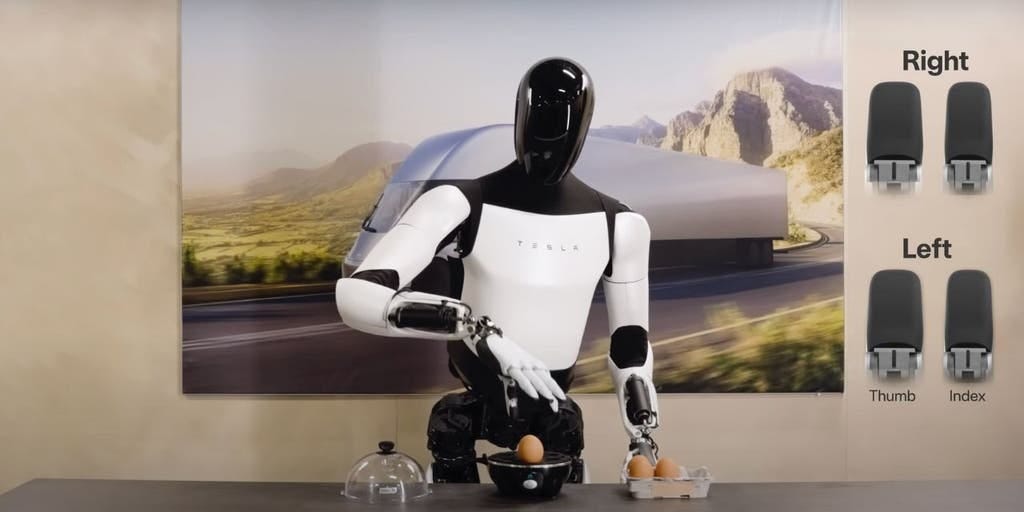
The reality is that more than a few doctors walking our sterile halls view both themselves and their patients as little more than organic versions of Tesla robots running (for the moment!) more advanced versions of ChatGPT. If you ask them, they will tell you this explicitly. And, after all, why shouldn’t they, as that is, increasingly, the “scientific consensus” of our time. Even those who don’t believe this in their minds often do somewhere down inside their hearts, for The System they are trained in has no room for any model of Man claiming divine origins. No room for any model in which he has a spirit, or a soul. In truth, modern medical education has no mythos more complicated than that of the Mechanic’s Garage, where dead, broken objects can occasionally be screwed back together, or, if not that, kept limping along a little while longer until they’re too expensive to maintain.
It is no wonder that euthanasia is so popular.
At a certain point, a clunker just has too many miles.
I did a rotation at Emory University once. I won’t tell you for what. In my time there, I became familiar with the Primate Research Center which, at the time, specialized in giving chimpanzees brain damage.
That’s a harsh way of putting it.
I am, I admit, being overly polemical to make a point.
Nonetheless, primate brains are the closest analog to human brains in the animal kingdom and, so, if you’re going to try and pioneer new brain surgery techniques, implants, or possible brain-to-computer interfaces…
You have to practice somewhere.
Both the legality and the ethics of doing your first trial runs on human test subjects, even willing ones, simply aren’t there. People say that’s preferable, sure, but one bad news story about a previously semi-healthy woman now foaming at the mouth because a novel surgical technique went bad, can get a whole department shut down. Even if she volunteered.
And all that is to say nothing of the lawsuits…
Monkeys don’t sue.
I believe the staff there to have been compassionate. I would bet they probably still are. I think they genuinely cared for the animals and their welfare but, when it comes down to it… when you’re faced with actually making the hard choices about minimizing suffering versus maximizing scientific gain… Well, what’s worse? To practice brain surgery on one chimp ten times, or on ten chimps one time? Is it more ethical to hurt many once, or one over and over again? More to the point… Which is more expensive?
Apes ain’t cheap.
“One over and over again” was therefore the prevailing wisdom and so… to put it nicely… it was not uncommon for the center to have some individuals who were… broken. One can only open and close a skull so many times and expect a full recovery.
This is medical research. This is how it’s done.
But it doesn’t feel like the pathway to “Health,” does it? I thought so then and I think so now. Something inside my soul rebels at the notion that we have to damage and kill in order to heal.
I freely acknowledge I might be wrong.
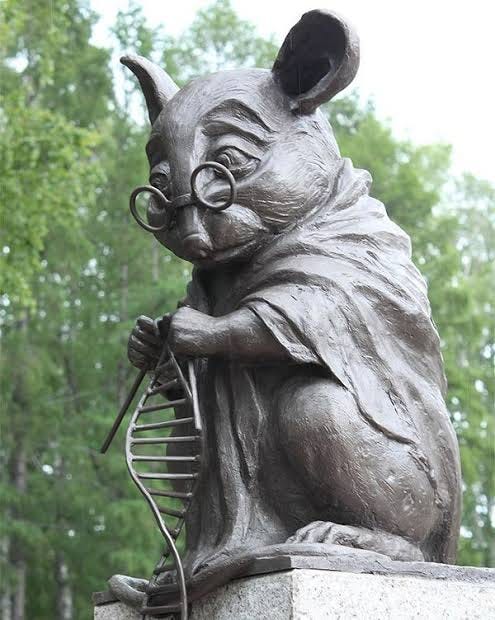
Those who take the counter position, who say that this kind of research is necessary, will point to past prohibitions of unseemly things and argue that such restrictions can only be a handicap to science. That, for example, medicine could only really begin to take off when all the taboos against dissecting bodies were lifted. When we dropped the whole “sacred human” act and just started dealing with the cold, hard facts. If current moral sensibilities were to get in the way of us experimenting on animals today, they argue, we would likewise be seriously hamstringing our abilities to understand, and therefore to combat, disease.
And, maybe so.
My perspective on it though, is that my long time colleague used to pet the beagles in his lab.

They were happy little dogs. Healthy ones. They’d wag their tails whenever someone came in through the door. My colleague would feed these animals, and pet them, and let them play with each other and, then, at the appointed time, he’d select one, sedate it, and cut out its still beating heart.
Many dogs died this way.
I don’t know how many.
He was doing complex experiments and needed the cardiac tissue to be fresh enough to still contract when stimulated with electrodes. As you might imagine, cardiac tissue does not remain “fresh” for long. Hence, a steady supply of beagles was needed.
I think the work scarred him.
He said it didn’t, but what would he know? Man is always in denial about his trauma. His marriage broke down. He developed an edge to him. He became estranged from his family and developed a slight indifference to cruelty. Adopted a sort of fatalism where the future is set in stone and nothing can ever change. He saw himself as a machine. He told me so, more than once.
Well.
Religious people, Christians specifically, often make the claim that “Science” has become the god of our age. That secular people, far from being atheists and worshipping nothing, are in fact religious zealots. Fanatic devotees to the cults of “Reason” and “Research.” Atheists pooh-pooh these claims. Yet, the fact remains that upwards of 100 million animals are killed in the name of scientific research each year, and peer-reviewed literature uses the term “sacrificed” for this. It says, in the journals, “the animals were sacrificed.”
One wonders if the pagans ever got anywhere close to that number.
It may have looked a little different, I grant you, but my colleague’s table with the still beating heart on it was assuredly an altar. One no less sacrosanct than any used by the Mayans or the Medes.

To the man’s credit he did invent something. Perhaps that balances the karmic books, I don’t know, it’s not for me to say. My colleague was, legitimately, the most intelligent man I’ve ever known, and perhaps one of the most intelligent to ever exist. Through this research he invented, almost from scratch, an entirely new imaging modality capable of mapping smooth and cardiac muscle via the curl of their magnetic fields. A technique which could, in theory, give you a functional 3D map of muscular electrical current via a bedside device.
It will probably never come to market.
Signal-to-noise ratio.
The bane of data processing everywhere.
Proving the theoretical feasibility of his technique was one thing, but SQUID (superconducting quantum interference device) magnetometers are almost impossibly sensitive. In almost every case the patient’s own body proved an insurmountable source of magnetic interference, a scenario only avoidable by isolating the anatomy you wanted to work with. “Isolating the anatomy” being, of course, Science Speak for, “cutting the heart out.”
Still.
All the heavy lifting is done.
The math, the technical specifications, even a handy reference guide for troubleshooting common problems… it’s all there, sitting in a 220 page dissertation somewhere on his university’s shelves, waiting for someone else to come along and solve the interference problem to create a functioning product. Whoever does will get a billion dollars. Easily. Wave a wand over someone and get a complete picture of their internal anatomy with zero radiation. Golden. Something out of Star Trek.
…
But would we be healthier?
That’s the question I could never quite shake.
Making this thing would give us more data… absolutely.
…
But would it give us more Health?
Of that, I’m skeptical.
I think I have a right to be.
I remain unconvinced that trying to approach the body as a machine or a computer is the true path forward, or that life and health can ever flourish from such a foundation of cruelty and death.
And I wonder if anyone agrees with me.
…
You know, really agrees with me.
Oh, people say that they do. You do too, reader, I’m sure. Knowing my audience, I can easily imagine most of you nodding along as you’re reading this, shaking your heads in disgust at the idea of sacrificing animals and swearing up and down that you decry all forms of transhumanism, and the attempt to reduce Man to a materialistic machine. “I’m no Elon Musk!” I hear you screaming. “I’m no Peter Thiel!”
But, you are though.
You are.
You are as deeply committed to the idea that More Information will allow you to solve your health problems as they are. As obsessed with the accuracy of diagnoses. As fixated on the finding the “root causes” of your symptoms. Searching, searching, searching, always looking for that one last piece of DATA which will finally show you how to fix yourself. You won’t admit it, but in every way you too act as though your body were a technical problem to be solved instead of a manifestation of divine soul. In practice, you’re every bit as much of a transhumanist as Musk and Thiel are.
They’re just more conscious of it.
And so, a public always gets the elites that it deserves.
He who seeks finds, and a lot of you continuously find things you don’t admit to be looking for.
Perhaps, then it is time to be honest about our searching?
In a real sense, Freud was the only true doctor of the last 200 years. The first (and, sadly, seemingly the last!) modern man to dispel the myth that people actually know what it is that they’re trying to get. The last man since Jesus to take seriously the notion that what you have is what you’ve asked for, and that every door swings open with a knock.
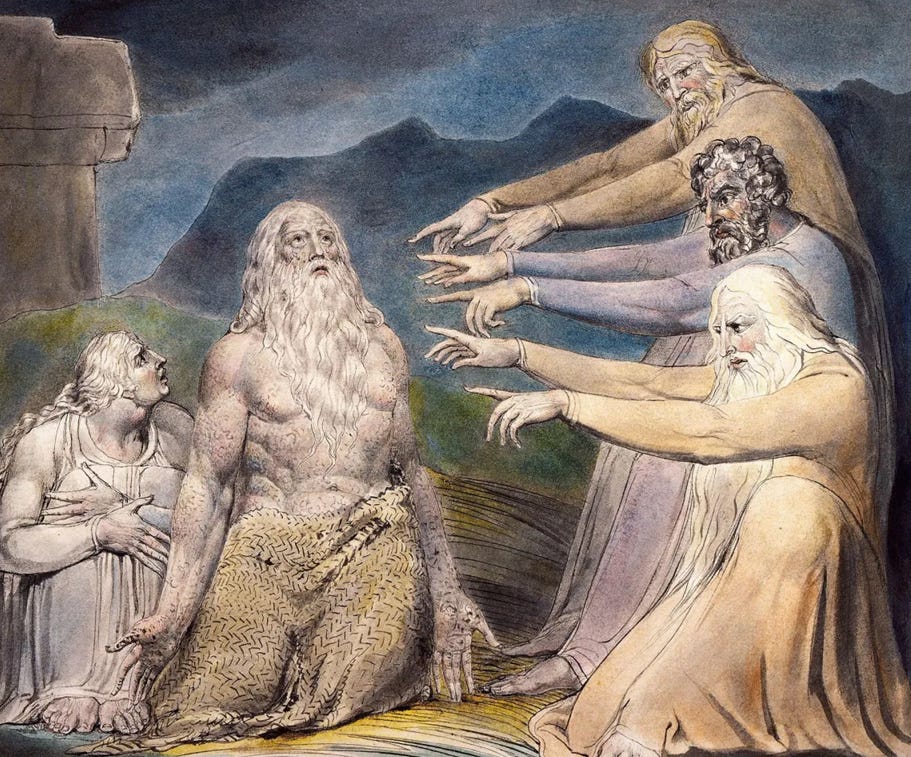
Job suffered from chronic illness.
Boils and that.
Open, oozing sores all over his body that simply would not heal.
Lost his family too. His wealth. Lost his standing in the community and the respect (and perhaps love?) of his wife. In the blink of an eye he went from being an exemplary man everyone adored to a byword and a social pariah. A healthy, vibrant, successful individual reduced to sackcloth and ash in the turning of an instant.
And what mattered to him most… is WHY? Why? That’s what he spends roughly thirty-eight of forty-two chapters trying to work out.
Not the pain, not the grief, not the shame…
But the Reason. The Why.
Yes, he is of course devastated by the loss of his children. Yes, he is distraught by the sudden financial ruin. Naturally, he is overcome with shame at the accusations of his friends and forlorn with despair about how his wife has given up on him and wants him to die. Yes! Sure! Of course!
But…
What he cannot get over… What is simply and truly unacceptable…
Is that he sees no reason.
The Loss, great as it is, is bearable.
The Nihilism isn’t.
The feeling that he lives in a senseless, random universe where one does not reap what he has sown… That, is what breaks Job’s soul.
“I just want to make sense of it.” That’s what people say. “I’m trying to come to terms…” The grieving say these things because the Human Soul can stand up to almost anything but Meaninglessness. Almost anything but random, cold indifference. As Nietzsche said, “He who has a why can bear almost any how,” and, after all, is this not exactly correct? For, if indeed the World is meaningless, then so too is Love. That being true would kill, not only our departed loved ones, but the fact that we ever loved them at all.
…
Intolerable.
“Religion is a crutch!”
Okay?
Are you in the habit of kicking the crutches out from beneath disabled people?
Look around. Life makes many cripples.

One of the only coherent takes on Job in modern times came from a morbidly obese man. Perhaps one of the only coherent takes anyone has had in the last 3000 years. Most have seen the ending of the book, where God appears to Job and, instead of answering Job’s demand for a justification of his suffering, shows him instead visions of all the wonders of creation, the seas and stars and plants and animals and skies. At first blush it appears that God is belittling Job. It seems the dodge of an abusive parent. God feels to us to be dismissing Job’s complaints by mere appeal to his divine power, as a father who, when asked why he has beat you, can cite no other reason than because that he is stronger. Because… “I said so.” We hear something like, “Who are you to question Me, Job?”, and we wince. We hear, “Did you hang the Pleiades in the sky or plan the wheelings of the Moon?” and we blush with both embarrassment and fear. Here God gives his longest unbroken speeches in the whole Bible, comprising four chapters, directly addressing a man questioning both the meaning and the justice of suffering and pain… and…
it’s so unsatisfying.
“Were you the one who made the mighty creatures of the deep Job? Did you set the sun upon its course? Was it you who said to this sea, thus far ye shall come, and no farther?”
As Chesterton's friend, Bernard Shaw, famously quipped, “If I feel that I am suffering unjustly, it is no answer to say, “Yes, well, but can you make a hippopotamus?”
…
But it is though.
As Chesterton noted, such is in fact the only answer.
“Why am I hurting?”
“Can you stop the sea?”
Because what is the sound of one hand clapping? What is the Buddha, if not three pounds of flax? Master, do even dogs have a divine nature? My son, truly, truly, I say to you, ‘Woof, woof.’
And so Chesterton saw what the monks missed because he was fat and drew pornographic pictures of women in his youth. God was not saying to Job, “Because I said so.” He was rather asking Job to reconsider if his demand for a reason even made sense.
“Sense…? Reason? Meaning?” God stares at back with a confused look and a wrinkled brow. “My dear Job, look around. Can you make sense of anything else? I don’t know if you’ve noticed, but this whole universe I’ve made is something of a madhouse. Reason doesn’t enter into it.”
And so it is.
As the fat man put it:
“It is one thing to describe an interview with a gorgon or a griffin, a creature who does not exist. It is another thing to discover that the rhinoceros does exist and then take pleasure in the fact that he looks as if he didn’t.”

Platypus.
A creature with the face of a duck and the tail of a beaver is no less fantastical than one with the head of an eagle and the body of a lion. The world actually isn’t “Rational”. Everything here is ridiculous! All that’s happened is that you’ve grown used to one particular brand of absurdity and called it Nature. Children know this. That’s why they’re constantly in awe and constantly surprised. It’s also why they’re constantly happy. They’ve yet to grow bored, which, after all, is simply another name for growing old.
Unless you change and become like little children, you will never enter the Kingdom of Heaven. — Jesus
Knowledge is a linguistic game we play. Wittgenstein forever vindicated. For almost everyone, what passes for “understanding” is simply Categorization, binning things together into this group or that. One in ten-thousand people ever move beyond this. Maybe as few as one in a million. Cradle to grave, we have it drilled in our heads that naming things somehow means you know them, our entire species being in the habit of mistaking stamp collecting for wisdom. From biology, to history, to physics, to even theology and morals, we never tire of creating “facts” and collating them into catalogues of our own devising, forgetting instantly that both the fact and the category we place it in are but abstractions of the human mind. “These creatures over here are mammals you see.” “These over here, reptiles.” “Over here we have History.” “Here, mythology.” “These sets of behaviors we’ve grouped together under the heading, ‘Wise.’” “These, under ‘Foolish.’” “This kind of result is Good.” “That kind of result, Bad.” “Such-and-such is Reasonable.” “So-and-so is not.” “This is normal.” “That is weird.” By such means we build up linguistic boxes and stack them high, a babbling tower of self-imposed import, our defense and fortresses against Meaninglessness, Chaos and all its crashing waves.
…
But God never agreed to our categories.
He never once signed on to our definition of what is “Reasonable”, or to what “Makes Sense.” No matter how high you build your walls, Time will knock them down. As the great poet Jimi Hendrix said, “Castles made of sand, fall in the sea… eventually.”
… … .
“Judge not.”
Divide not the world up into different bins.
“Why do you call me Good? There is none Good, but God.”
It is perfectly true that a mind steeped in judgment cannot reconcile a loving God with the Suffering of the world. With the death of a child or a tragic accident. With a cancer, or a burned down home. But! Such does not go far enough. People refuse to push the Problem of Pain until it is reduced to the absurd, for neither can such a mind reconcile God with the existence of mosquitos, or salmonella, or the fact that wolves have fangs. Those who would divide the world in bins have no answer for why God would command his followers to have no other gods “before me”, and not simply to have no other gods. They cannot process a command about not killing mere pages before a mandate to commit genocide. Such a mind looks up to Heaven and thinks it understands the stars without ever considering why they sometimes fall. It speaks glowingly of Eden… never questioning why God himself would let in a snake. The righteous men of the world, the would-be Peters and the would-be Pauls, those who claim to know God by their own categories, on their own terms…
If such men were given divine power they would destroy everything. It would be a plague of perfection.
A holocaust of holiness.
In the name of God and what they think him to be, they would wipe the world clean of all its spots. They’d pull the lust and gluttony out of men and women as surely as they’d blink all ticks out of existence, put an end to every hunger pang, and forcibly yank the claws from every lion, making them lie down against their will beside a lamb.
But Solomon…
The man God himself called the wisest to ever live…
He set up altars to pagan deities. To Chemosh, and Molech, and Ashtoreth, making a place in Israel for all that Israelite religion deemed Detestable.
…
And God punished him for it.
As Solomon, wisely, knew that he would.
It is “Pride Month.”
Have you ever asked yourself why God would prohibit homosexuality while, also, apparently making so many homosexuals?
Solomon knew the answer to these things.
Paul did too.
As The Apostle says, “There is now neither Jew nor Greek, Male or Female, Slave or Free…” and he comes across as a madman because he is attempting to speak about the unspeakable, obliterating the categories by which his audience would have attempted to understand. Moderns find his language harsh and abrasive, but this is only because they read him as a moralizer and not a mystic. A man trying to “start a religion”, instead of someone “caught up to the third heaven” trying to desperately to explain what he has seen.
…
“For God has consigned all to disobedience, in order that on all he might have mercy.”
Chaos is a feature.
Not a bug.
And so Medicine is not actually seeking Health you see.
It’s seeking Control.
That’s what it’s actually looking for, and that’s what it actually finds.
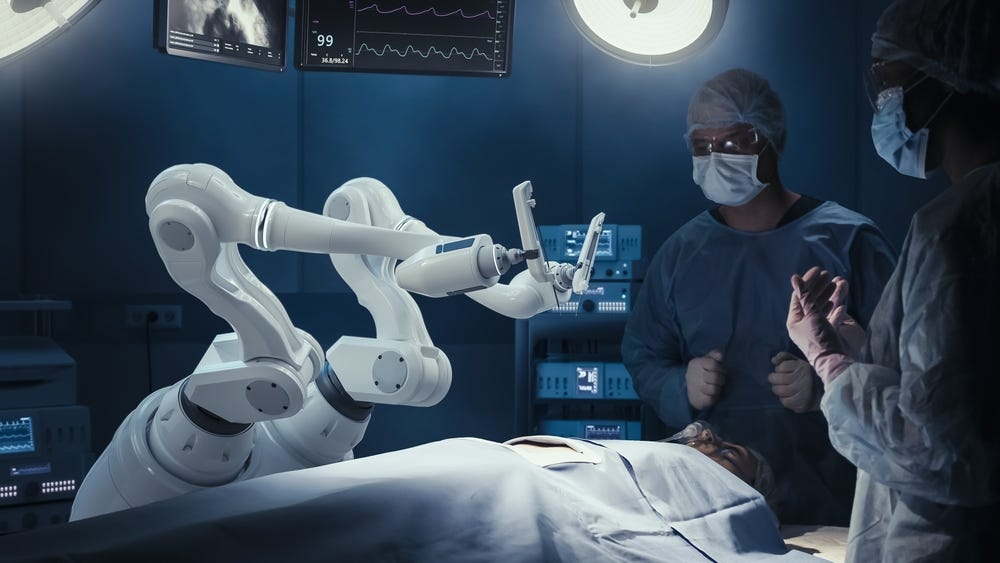
It’s a lack of faith. A desire to calm the waves, refusing to realize that the tempest makes the ocean what it is. Contra our stated desires, neither the modern doctor nor the modern patient have as their primary aim the patient’s health, but rather control over the inner workings of the patient’s body. The eradication of the unexpected and abnormal. The reduction of randomness and the enforcement of conformity. The ability, we imagine, to play God.
…
But ironically God does play dice.
The very thing we fear to do.
Of course, I am being hypocritical. I am well aware of all the ways in which I contradict myself. Forgive me. There is no way around it when skirting the edge of what is effable. “Yoshi? Is not your criticism that people judge too much itself a judgment?” “How is Health even to be defined if we are unwilling to classify states of being as Good or Bad?” “How can God find fault if it is he himself who has placed that fault within us?” and, “Are you not yourself Yoshi, a beneficiary of the very medical system and attitudes you now decry!?”
Yes and yes and yes twice more.
You are right.
I’m frustrated with me too. I’ve gone round and round trying to make my Intuition clearer. This is the best that I could do.
…
And yet… I am right.
For what was Adam and Eve’s sin? For what, precisely, were they condemned? For eating from the Tree of Knowledge? No. For eating from the Tree of the Knowledge of Good and Evil.
That’s a Tree of Judgment. A Tree of Dualism. A Tree of dividing up the world into separate bins and classifying this over here as okay and that over there as not.
A Tree of thinking you know best.
Adam and Eve ate from that tree and instantly, upon the moment they swallowed, Judged their bodies as inadequate and needing modification. Judged the world as harsh, scary, untrustworthy and unsafe.
And so, how many c-sections are done simply because we’re trying to force a mother and baby to adhere to some “normal” timeline? How much of the terror of pregnancy is simply anxiety over all one can’t control? Is not man enslaved, not by his government, nor his boss, but rather by his fear of the future? Convinced that God will not provide for his needs and that he must toil, save, and plan or else starve and be destroyed?
In pain then did Eve bear children.
By the sweat of his brow, did Adam work the land.
You see, when Paul said that women would be saved through childbearing… he was not being misogynistic. He was saying rather that salvation is found in giving up control. In radical faith. In allowing one’s body to be worked on by the unpredictable forces of Nature, Love, and Eros without knowing how it will go, just as Christ’s disciples had to learn to go out into the world and thrive without bread, bag, or money, rejecting the “masculine” urge to be the master of their own fate and force their will upon the world.
It’s about getting back to Eden.
Having faith enough to undo The Fall.
It’s about realizing that you actually can’t tell the sea where to stop, or the sun when to rise, and that all your fantasies of ordering existence to suit your definition of “Correct” are both completely impossible and absolutely unhinged.
It’s about letting go.
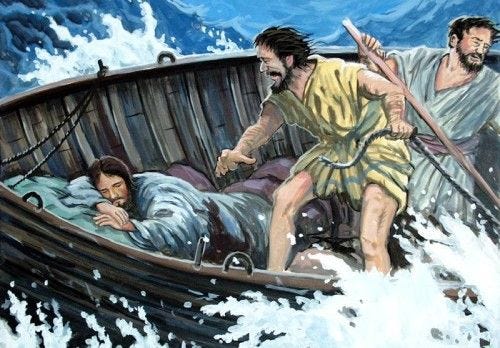
For my part, I don’t think it’s a coincidence that the Man who could heal the sick was also completely undisturbed by the raging tempest in the sea.
The ocean of all you don’t know and can’t control is endless, its waves enormous, and your sandcastles of Control, Reason, and Order, all destined to fall.
The only thing you can do is have Faith.
Give up.
When you do, miraculously, you find that you can step out onto the waves, and walk.
You’re quite an interesting chap Yoshi. Why do you write? Why do i enjoy it? Why are you interesting? All interest is judgment. How do we point to the pearl of great price? There is no pearl and price is an even greater nonsense. May the peace that passes all understanding be with us all.
There's a lot in this article to address - but I really like your observation on the religion of science and its many animal sacrifices. It maps so well, its amazing I never thought of it or heard someone else mention it. I will say the old pagans usually at least got a nice meal (and maybe a dance party) from their sacrifices though. Modern religion is just too sterile.