

Fearing God
How to Worship Yahweh and Still be a Pagan

So Paul stood up and, motioning with his hand, said: “Men of Israel, and you that fear God, listen…”
— Bible, Acts of the Apostles 13:16
Brethren, sons of the family of Abraham, and those among you that fear God, to us has been sent the message of this salvation.
— Bible, Acts of the Apostles, 13:26
On Tossing Out Jews

Jews have always had trouble fitting in. This is, in my opinion, somewhat their fault.
Now. Don’t worry. I’m not now going to launch into some antisemitic tirade or anything, en vogue as such might currently be. Instead, I’m merely pointing out the fact that the Jewish belief system, especially its peculiar definition of “holiness”, makes it very difficult for them to ever completely jive with other cultures.
To the Jewish mind you see, “Holiness”, means separateness. Set apart. Holy things are distinguished to large degree by their “set-apartness” from common, vulgar things, in much the same way that one keeps one’s spouse set apart from other men and women, solely for one’s self. In the Hebraic mindset (I speak broadly out of necessity here, we much always keep in mind that the range of Jewish opinions is large), being a holy people while also simultaneously fully integrating into another culture is simply a contradiction of terms. It’s not possible. So it is that Jewish diasporas have historically tended to form ethno-religious enclaves within whatever culture they’ve found themselves in and, in many cases, sought a degree of political and legal autonomy from secular authorities. Thus they did in Ancient Rome, thus they did in medieval Europe, and thus they do today, in Brooklyn NYC.
No judgement here.
I’m not saying this is good or that it’s bad. I’m just saying on a merely factual basis that that behavior has tended to cause problems. Jewish religion, if followed faithfully, really does almost require Jews to seek out a separate (again, holy) set of rules for themselves. I’m not saying they get “special Jew laws” or something (although, yes, that does happen sometimes, see, for example, U.S. states attempting to make boycotting Israeli companies illegal), it’s more of an attitude of “Hey… we’re going to keep this in house. Jewish business is Jewish business, and it’s not really for outsiders to adjudicate upon.”
Fair enough.
Jews are by no means the only people who do this of course. The Amish also famously keep their affairs “in house” and don’t often seek recourse from the secular authorities, as do, here and there, various enclaves of Muslims. But, I would say, Jews are the best at it. Their culture, while on one level being very open to the world, is on another exceedingly insular. Again. Not good. Not bad. Just how it is. And, if this separateness and insularity is perceived as unfair by others (as it inevitably will be sooner or later), well… then Jews can often become the scapegoat for whatever problems a society is currently facing. That’s just the reality. I don’t think an honest look at Jewish history can lead anyone to conclude otherwise.
Now, personally, I regard the Jews as normal people. That sounds patronizing but it’s not because the world is full of those who either think that Jews are demons or that they (and by extension Israel) are angels who are always innocent and can do no wrong. Both of those views are racist, just in opposite directions, and I think the only correct view is to say that they are as capable of vice or virtue as any other group and that they, on the whole, are similarly about as innocent and guilty on the historical stage as everybody else. A people who (again, like everyone) have had great crimes committed against them and who, also, have occasionally committed great crimes. Most of the “expulsions of the Jews” from various countries have been without reason, driven by fears stoked by the insularity of a minority group. Others appear to have been for very real reasons, as it seems like in some cases insular Jewish groups were actually abusing positions of power. I use the words “reasons” and “without reason” here intentionally, to convey a lack of moral judgement about it. I’m not saying the expulsions were ever good, I’m saying that, in some cases, the reasons given for doing it were purely fictitious and, in others, had some basis in reality. I’m holding the Jews as a neutral party. A group of humans like any other, capable of innocence and guilt, mostly playing by the rules but occasionally cheating.
I think that’s fair.
The difference is that their religion, their intense separateness, can tend to exasperate otherwise normal problems with other groups because their faith basically requires them to constantly “other” themselves. You know, it’s not a low-level religion, Judaism. It’s quite a hardcore belief system and it asks a lot of you. Needing specially prepared foods, not being able to do any labor on Saturdays, having to cut off the foreskin of your penis, all those special holidays… actually following Judaism makes you different from non-Jews. Inherently so. Way more than simply being another ethnicity or race does. Again, not better, not worse, but…. definitely different, and different in a way that makes it hard to ever completely mesh with other peoples.
It is what it is.
A Butting of Heads
I have a friend who routinely frames the world in terms of “Greco-Roman Universalism” versus “Abrahamic Tribalism.” I think that’s a good way to see it. All the Abrahamic faiths have varying tendencies towards insularity, but Western Culture is unique in that it has always struggled between that and the opposing Roman impulse to bring anyone and everyone into the fold. That is, after all, what Rome did. Rome, Pagan Rome, was The Inclusive Empire par excellence.
“Ah! You’ve got a storm god? Fantastic! We’ve got one too. Come on, come on. Let’s get him a seat at the table.”
“Hello there! Oh! I see you’ve got some strange sex practices ya? Wink wink, nudge nudge. No worries mate. Oh you wouldn’t believe what they get up to over at the cult of Dionysus. You’ll fit right in. Welcome, welcome.”
“‘Allo ‘allo! Good to meet ya. Name’s Brutus and this here’s me brother, Cassius. Yep, yep. That’s right. Form a line. Fertility cults to the left, blood sacrifice to the right. There we go. Let’s keep it moving.”
“Greetings! Oh, you don’t eat pork!? How interesting. Well we’ll just… eh? What’s that? You uh… you cut part of your willy off? That right? Hey Cassius… I think this one’s a bit daft in the head…”
It really was kind of like that.
Roman bath houses, which, despite the name, were more like modern day spa-gyms where citizens would go to exercise and steam in the nude, were famously places that Jews felt unwelcomed. Circumcised penises were seen as strange, an absolutely bewildering practice to the pagan mind which otherwise accepted so much, and though Jewish citizens were as entitled to use the facilities as anybody else, having the one set of different genitals from everyone else in the building was probably fairly awkward. Moreover, unlike most of the pagans, whose religions were more loosey goosey… Jews couldn’t ever really relax their rules. There wasn’t a “Hey, how bout some bacon, just this time” at the neighborhood barbeque, and, because Roman military service normally required soldiers to sacrifice to pagan gods, outside of special accommodations by the State, faithful Jews couldn’t even participate in the Legion, arguably the most iconically “Roman” thing there was to do.
Again, this isn’t anybody’s fault, it’s just a fundamental difference of worldview.
See, the thing about Abrahamic religions is that they believe in rules. This isn’t to say the pagans didn’t but… yeah… they kinda didn’t. To the pagan mind the gods were, like Nature, a mixed bag. Zeus, Hera, Mithra, Aphrodite…these beings were divine because of their power… not because of their intrinsic goodness. Whereas Abrahamic faiths believe God is a) One and b) Wholly Good, and this naturally implies that there is a) one way to worship him and b) actions which always align with his goodness and actions which always don’t, The Pagans, by contrast, believed the divine came in all sorts of forms and was just as likely to be loving as it was to be an asshole, so, naturally, it followed for them that there was no “best” or “correct” way to worship it and that you could, as indeed the gods themselves frequently did, now and then “bend the rules.” When those two ways of looking at the world met, well… they were inevitably going to bump heads. If those two philosophies can ever be reconciled, how is not at all obvious and, indeed, one might say that even today the two political poles of Western Politics represent those two opposing worldviews, Conservatives with their narrow, insular, “there is a right and there is a wrong” way of looking at the world and Liberals with their broad, open, “Hey man, whatever,” mindset. It’s Rome vs Abraham. Jupitar vs Yahweh. Apollo over and against Jesus Christ.
And it really is that question all the way down.
Isn’t it?
What divides our society, fundamentally, is not progressive versus reactionary or black versus white or gay versus straight. No. It’s much more primal than that.
What divides us is that same age-old conundrum. “Is there one? Or is there many?”
The Grand Synthesis
My thesis here is that, actually, Christianity comes fundamentally as an answer to the question of The One and The Many. That Jesus, and the way his followers presented his actions and teachings, resolves this problem, melding the polytheist and the monotheist mysteriously into one, such that the boundaries between the two ways of looking at the world ultimately dissolve. What, after all, is The Trinity but the outlandish (and often incomprehensible) claim that plurality and singularity are secretly the same?
Going back to the beginning, again, one of the few people groups Rome could not fully integrate was the Jews. They tried, certainly, and had some success because, since at least the campaigns of Alexander, the Judaic world had been heavily Hellenized. Still though. In the end, though both sides tried to make it happen… they just couldn’t quite get there. Yahweh. Jehovah… he simply wouldn’t be integrated into the pantheon. No matter how hard anybody tried to force him.
Rome you see had very formal state sanctioned rites for welcoming new gods and goddesses into the official rolls of the Roman Pantheon. New gods of new peoples entering the empire would be introduced to the rest of the citizenry, have their myths propagated by town criers, and, with official pomp and circumstance, have shrines set up to them around the country, all at state expense. Upon first encountering the Jews, Rome naturally wanted to do the same with Yahweh but, again, because the Abrahamic mind equates “holy” with “separate” in a way the pagan mind simply doesn’t, this just wasn’t possible. To admit Yahweh into a pantheon… to say there were other beings like him, possibly equal or greater in power… well… that would mean Yahweh was no longer separate and, therefore, no longer holy. The Jews couldn’t do it. Tempted as they might have been to receive all of Rome’s worldly benefits, in the end they could not allow their god into the ranks of other gods and, because of that, once again became something of an “other” in society. They became a prickly spot. A “Hey… those people don’t quite fit in.”
Ultimately of course this societal incompatibility would culminate in the destruction of the Temple in Jerusalem (Read, “The Jewish War” by Josephus) in 70 AD, an event which, still, to this day, the Jews have yet to recover from, as they’ve never had a temple since. Indeed, much of current day Israeli-Arab tensions result from a desire to erect that Temple again, which would require the destruction of the Al-Aqsa Mosque currently built in the former Temple’s place.
Again, I’m not blaming the Jews for any of this, and I’m also not not blaming them. The Roman-Jewish war was, like all wars, partly the fault of both parties. I’m again simply trying to point out that the otherness of Abrahamic thought lends itself easily to conflict with other cultures which do not view The Divine or the cosmos in quite the same way.
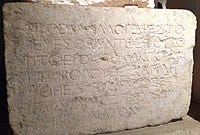
Sort of beautiful thing about the whole affair though was just how close Jew and Pagan came to a workable solution. Both The Romans and The Jews tried, and for a long time succeeded, to accommodate Jewish life into the wider Pagan sphere. To the credit of both parties, each went about as far as their respective faiths would allow in trying to build bridges with the other. So much so that Romans routinely contributed money to the building of synagogues and, in return, Jews would often include (perhaps somewhat scandalously) iconography of pagan gods inside those same buildings.
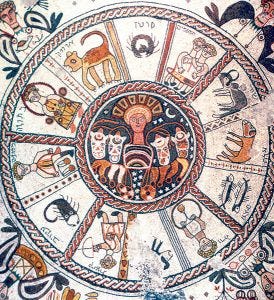
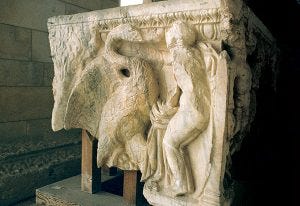
Examples of such are endless.
As I said, while there were conflicts, and some factions of the Jews really, really hated The Romans (they had reason, Rome, after all, had conquered them)… at the same time there were large factions of Jews trying to extend the hand of friendship.
Same on the Roman side.
So great was this mutual back and forth in fact that an entire class of person was born: The God Fearers. Pagans who nonetheless worshiped the God of Israel with Jews on The Sabbath.
Don’t believe me? Well, besides being widely attested in the archeological record, they’re also in The Bible, although if you don’t know to look for them you’ll probably pass over the places where they’re mentioned without noticing. In the verses I quoted at the beginning of this post, Paul uses the term twice, and, like I say, if you don’t know any better it’s easy to look at his words and just assume Paul’s simply being nice. You know, like, “Oh, hello, men of Israel, you who fear god.” That kind of thing. But that’s not what he’s doing. No. It’s men of Israel and “you who fear god.” See, Paul was going around the Roman Empire, preaching Jesus in the local synagogues, and encountering communities where both Jews and Gentiles had gathered for worship. Paul was preaching to The God Fearers.
Paul was preaching to Pagan Jews.
And this just makes sense. If you’re trying to spread a new religion the most effective way to gain followers is to go to those already primed to hear it. If Paul had spent most of his energy preaching at, say, the Temple of Apollo, he’d have had to have spent days, maybe even weeks, walking those people through the contextual history of the Bible and Jewish theology, before he could even begin to make a coherent pitch to them about Jesus as that theology’s fulfillment. By focusing first on The God Fearers, Paul is targeting a ready-made audience, Pagans who are already familiar with the basics of Old Testament stories and the Jewish religion. Have you ever wondered how Christianity spread so quickly? There’s your answer. So many pagans converted because they were, actually, already very interested in Judaism.
Two things here to note.
One, we’re not talking about a small group of people. Good estimates are hard to come by but there were in all likelihood hundreds of thousands of God fearers in the Empire at the time of Jesus. Paul isn’t slacking by targeting this demographic. It’s a large and thoroughly necessary mission field.
Two, these are not converts. God Fearers were not converts to Judaism. They were simply… I don’t know… Jew Adjacent. They remained uncircumcised and made no pledge to keep The Torah. They were pagans through and through, just… pagans interested in Judaism. As mentioned, outside the Bible attestations to the existence of the God-fearers is strong in the archeological record, most notably on various plaques and memorials left behind on Jewish houses of worship throughout the Mediterranean. In the same way that, today, a wealthy benefactor might give a lot of money to a university and thereby get his name on a building, in Rome, the more wealthy of these pagan God-fearers would donate money to the synagogues and, in return, get their names inscribed on a nice plaque made of stone. Thanks to this, The God-fearers are not abstract historical hypotheticals to us, but a group of people with names, faces, and occupations that we know. One, for example, was from a family of pagan priests. Another, a high-ranking army official which, as mentioned, ipso facto would’ve required him to worship pagan deities.
In light of this, the story of Christ’s healing of the centurion’s servant in The Gospel of Luke takes on new meaning. Listen:
After he had finished all his sayings in the hearing of the people, he entered Capernaum. Now a centurion had a servant who was sick and at the point of death, who was highly valued by him. When the centurion heard about Jesus, he sent to him elders of the Jews, asking him to come heal his servant. And when they came to Jesus, they pleaded with him earnestly, saying, “He is worthy to have you do this for him, for he loves our nation, and he is the one who built us our synagogue.” And Jesus went with them. When he was not far from the house, the centurion sent friends saying to him, “Lord, do not trouble yourself, for I am not worthy to have you come under my roof. Therefore I did not presume to come to you. But say the word, and let my servant be healed. For I too am a man set under authority, with soldiers under me: and I say to one, "Go,” and he goes; and to another, “Come,” and he comes; and to my servant, “Do this,” and he does it.” When Jesus heard these things, he marveled at him, and turning to the crowd that followed him, said, “I tell you, not even in Israel have I found such faith.” And when those who had been sent returned to the house, they found the servant well.
— Bible, Luke’s Gospel, 7:1-10
Interesting. No?
Again, just to be super clear, there’s no question at all that the centurion in this story is a pagan. The standards that the Roman military carried doubled as small portable alters which allowed centurions like himself to sacrifice to the gods before, after, and even during battles. As anyone who’d ever read Homer knew, the one thing that was absolutely necessary to win wars was the gods’ favor, and without that you had nothing. Well, the Roman State took this to heart and appeasing the gods through sacrifice was, for a Roman Centurion, literally part of his job description. So here in this story we have a man who, as part of his day job, makes actual animal sacrifices to some deity like Juno or Mercury who yet, nonetheless, according to Jesus, has faith in the God of Abraham unlike any in Israel.
Bizarre, huh?
Well. What can we say? Man is a paradox. Truly nobody fits within our neat and tidy categorical boxes.
To make matters even more interesting, it’s not at all clear that these God Fearing worshipers of Yahweh were actually worshiping Him under the name… Yahweh.
In fact, in many cases, we know they weren’t.
Often the God Fearers were at the synagogue worshiping their local version of the most supreme deity, which they regarded as functionally equivalent to Jehovah. We know, for example, that the god Caelus was a popular target of reverence for The God-fearers, as were other deities like Uranus and Zeus. Worshiping Israel’s God, they reasoned, need not necessitate a rejection of their own mythology, nor, apparently, did the Jews around them feel much need to pressure them to do so either. The attitude appears to have been something more like, “Listen. We Jews have a great sky god, and you pagans have a great sky god. Great. Now, our myths about him differ, sure, and we think maybe our myths are better and more true than yours but… even so, there’s no need to go throwing the religion of your ancestors in the trash or anything. Just worship ‘The One’ under whatever name you’re most comfortable with. We’ll call it good.”
Pretty wild.
I mean, can you even imagine such an approach to religion flying today? Orthodox Jews or Christians or Muslims saying, basically, “Yeah, sure. Go ahead and worship Odin. Basically the same as our guy anyway.”
I can’t.
It’s popular these days to believe that the past was universally more strict and more dogmatic than the present, and certainly there have been times when that’s been true. However, if you go back far enough you inevitably discover that History has been anything but a linear march of progressive tolerance. Periods of rigidity alternate back and forth with periods of laxity, and believers of all stripes in Jesus’s day were apparently very libertine.
Indeed, by focusing their missionary efforts on The God-fearers first and foremost, The Apostles could be seen as giving implicit approval to such an approach. We don’t have records of them saying such outright of course, but the non-Jews they were preaching to were, almost to a man, convinced that Yahweh and Uranus or Zeus were expressions of the same deity… and the Apostles never felt the need to correct that. In fact, completely to the contrary, The New Testament features a radical embrace of Greek Philosophy and pagan theological concepts, so much so that Jesus himself is identified with The Logos, a Greek philosophical term that some sects considered one and the same with Zeus. Further, Greek mythological terms and gods, like Hades and Tartarus, make open and unabashed appearances in the New Testament Apostolic Letters:
For if God did not spare angels when they sinned, but cast them into Tartarus and committed them to chains of gloomy darkness to be kept until the judgment; if he did not spare the ancient world, but preserved Noah, a herald of righteousness, with seven others, when he brought a flood upon the world of the ungodly. — Bible, 2 Peter 2:4-5
Now, the Bible you have on your bedside table probably reads “cast them into hell” here because Christianity has since become very uncomfortable with all such Pagan/Judaic blending but, rest assured, in the Greek St. Peter uses the word Tartarus… the place in Greek mythology where The Titans were cast after the great war between The Olympians and “The Old Gods.”
So here we have Peter himself, first among the apostles, seeming the validate the idea of equivalency between the mythologies. The “Angels when they sinned”, of course, refers to The Nephilim and so what’s actually going on here is that we have Saint Peter saying, rather explicitly, “Hey… Those Nephilim in our Jewish texts? Same things as your Titans.”
Pretty crazy.
And then we have Jesus in The Gospel of Matthew:
“And I tell you, you are Peter [“The Rock”], and on this rock I will build my church, and the gates of Hades shall not prevail against it.
— Bible, The Gospel of Matthew, 16:18
Again. Same story. The Bible in your house probably renders that as “the gates of hell” but it’s supposed to be the gates of Hades. That’s what Jesus actually said. “Gates of Hades.” Yes. Hades. Zeus’s brother.
This guy:

Without going too far, because I do think the character of The Divine as revealed in different mythologies matters, it really does seem like, for the Christians and Jews of the first century, viewing pagan gods as alternate versions of Jewish mythological figures, including Yahweh himself… was a valid thing to do.
Let the one who is able to receive this, receive it.
Catholic
If you can receive it… suddenly, so many things make sense. The statues of Roman gods left standing after centuries of Christianity in Italy. The calling of the days of the week by the names of Norse gods. The overtly pagan origins and trappings of Easter and Christmas, which we, sometimes, still call by its pagan name, Yule. The centuries of theology overflowing with the ideas of pagan philosophers. Shakespeare’s characters invoking Jove. The tradition of saints with their little shrines dotting the landscape like local spirits with holy wells…
If you have it in your mind that Christianity was or ought to be like Islam or the modern expression of Judaism, then all these things are puzzling. Shouldn’t we have, long ago, given up on having Thor’s Day before Friday (aka Frigg’s Day (Frigg being the Germanic version of Venus))? If they were actually faithful to their religion, ought’n’t Europe have dispensed with all those statues of Aphrodite and Poseidon? How is it that Catholic theologians justified their belief in the real presence of Christ in the Eucharist via the intellectual framework of a man (Plato) who likely believed in the goddess Demeter? Shouldn’t they have torn all that down? Ought they not be Abrahamists through and through?
No.
Because Christianity was a syncretic religion from the very beginning and the faith rests fundamentally upon the claim that Opposites, are in fact the same.
That God is Man and that a Man is God. That Spirit can be made flesh. That Jew and Gentile are the same and that between Chosen and Unchosen there is no division. That multiplicity and singularity need not be at odds and that, behind it all, The Many are, in fact, expressions of The One.
Lo! I am come to autumn,
When all the leaves are gold;
Grey hairs and golden leaves cry out
The year and I are old.
In youth I sought the prince of men,
Captain in cosmic wars,
Our Titan, even the weeds would show
Defiant, to the stars.
But now a great thing in the street
Seems any human nod,
Where shift in strange democracy
The million masks of God.
In youth I sought the golden flower
Hidden in wood or wold,
But I am come to autumn,
When all the leaves are gold.— “Gold Leaves”, G.K. Chesterton
Father Bede, lifelong friend of C.S. Lewis, was once asked by a disciple to his ashram in India, how it was that he, a Catholic and a Benedictine monk could rise every morning and perform the sun salutations of Yoga.
His reply? “Because it’s catholic.”
Because it’s universal.
Because Christ is and will be all in all and, as Lewis put into the mouth of Aslan The Lion, there is no worship pure of heart to any deity that the true God does not consider “Mine.”
Omnia vincit Amor.
This syncretism may have a root all the way back in Genesis, depending on how you want to interpret the Melchizedek story in Gen 14:18-20. Joshua 24:2 shows that Abraham was called out of a pagan culture to be set apart for Yahweh's purpose of building a new nation faithful to Him alone. This goes with your definition of holiness. But the mysterious meeting of Abraham and Melchizedek shows that Yahweh may have been worshipped by pagans in Abraham's day. Melchizedek was a king and priest of Salem (i.e Jerusalem before Israel's conquest of it). His name is a theophoric that means "my king is Zedek". So he is literally named after the Canaanite sun god. Yet, he is called a priest of God most high. So...a guy named after a pagan sun god living in a pagan city-state also serving as a priest of the God of Abraham. This suggests that Yahweh may have been part of different ancient pagan pantheons. Then in Psalm 110 and in Hebrews this guy gets described as a type of Christ! Pretty wild.
Brilliant. Thank you. See this also: https://open.substack.com/pub/addisonhodgeshart/p/a-reflection-in-paschaltide-addendum?r=3ezew&utm_medium=ios
Two orthodox theologians. The first , Cutsinger, is excellent on the many valid paths to the top of the mountain (and some invalid ones). And the second is also excellent on heresy and diversity in early Christianity.